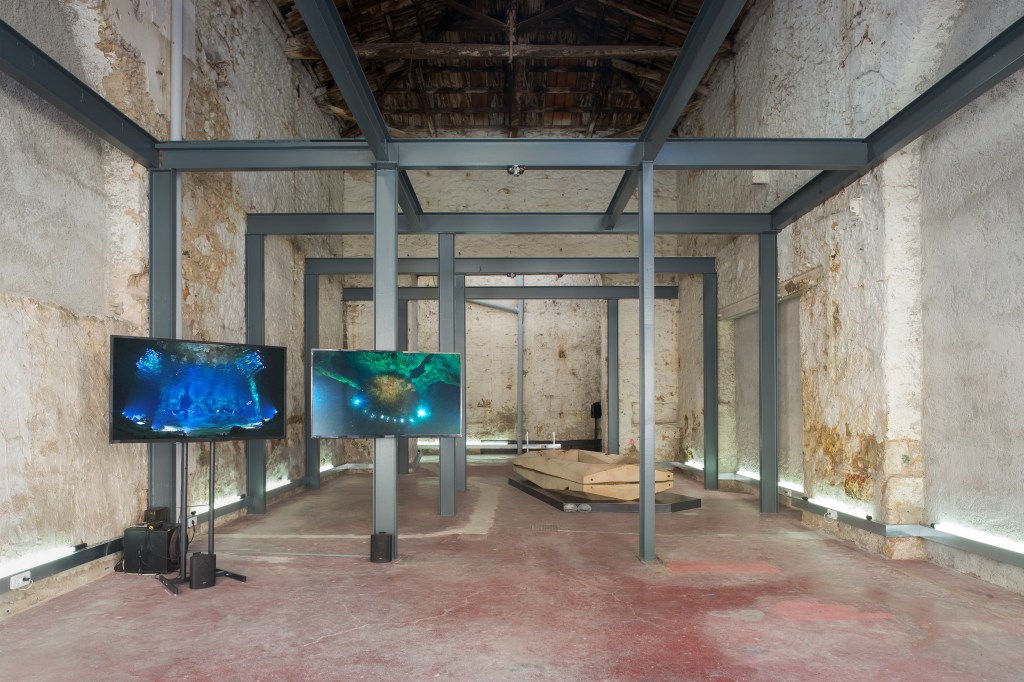
As part of the Art Explora Festival, ATOPOS cvc x Office of Hydrocommons presents Liquid Ports, a group exhibition curated by Eleni Riga with works by Ileana Arnaoutou & Ismene King, Despina Charitonidi, Eleni Mylonas and Maria Nikiforaki, unfolding a visual exploration of artistic practices with water in the Mediterranean Sea, as both an embodied and critical geography. From the perspective of the Mediterranean South, ecological pressures and the uneven impacts of climate inequalities reveal the fragility of both human and more-than-human communities. Liquid Ports traces these tensions through an ecofeminist lens, foregrounding the port as a space of resistance and resilience.
1. Maria Nikiforaki, Hydrodance: Elephant Cave, 2023, Two-channel video, Full HD, color, sound, 13′ 32′′. Courtesy of the artist and ATOPOS cvc x Office of Hydrocommons.
With this audiovisual work, Maria Nikiforaki invites us to hold our breath and take a dive into a liquid world. Using the Elephant Cave in Crete as a backdrop, she stages an original underwater choreography that appropriates the vocabulary of marine biology and diving. The site is chosen symbolically as reminders of the risk of biodiversity loss due to anthropogenic activities. The spiraling movement of the divers participating in the choreography evokes the circular dance of fishes or sea mammals, and witches who were none other than farmers and healers of the previous centuries, threatened with a loss of their natural habitat. At the same time, the filming with cameras that are attached to the bodies of the divers – and specifically around the abdomen, alludes to the cameras embedded in the backs of marine mammals (Crittercams), used by scientists to record video, audio, and other information related to aquatic life.
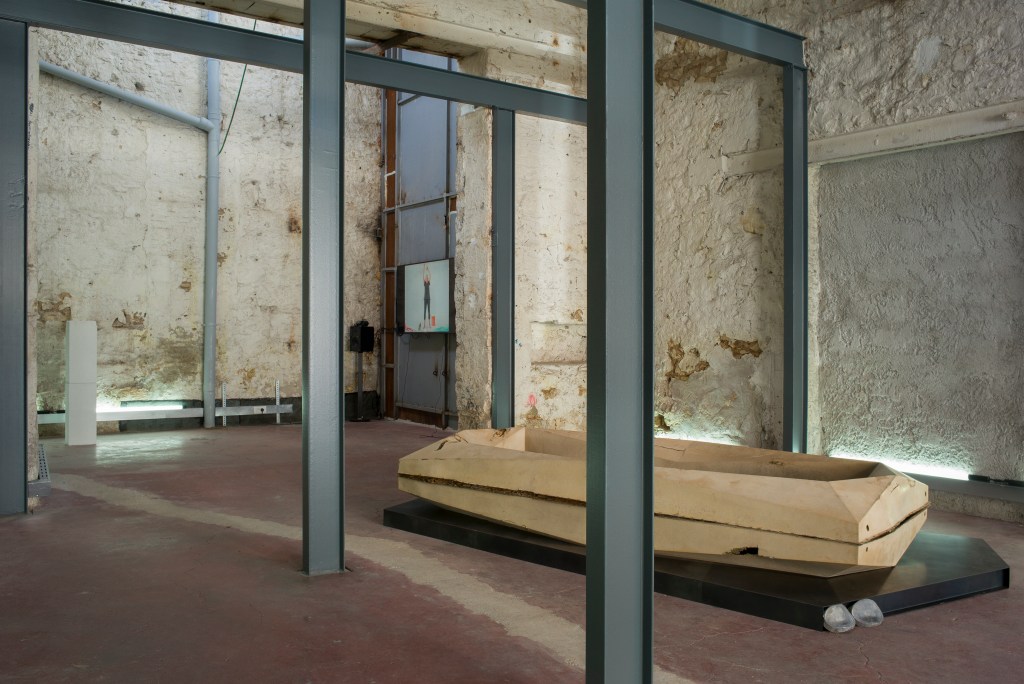
2. Ileana Arnaoutou & Ismene King, Saltbody Craft, 2025, polyester, resin, mild steel, aluminum, 350 × 180 × 50 cm. Courtesy the artists & Callirrhoë, Athens.
At the center of the work lies an abandoned lifeboat, retrieved from a landfill on the island of Aegina. By rescuing the boat and installing it onto a metal platform that acts as a carrier, the artists draw attention to its polyhedral, futuristic design and its original role as a vessel of survival. Suspended between obsolescence and renewal, the lifeboat echoes the port’s shifting tides of layered histories of migration and trade. This gesture extends the duo’s ongoing investigation into Aegina’s unclassified burial cavities, linked to the warriors of the ancient battle of Salamis. Across their practice, Arnaoutou and King trace the intersections of industrial and organic decay, exploring the afterlives of labor and matter.
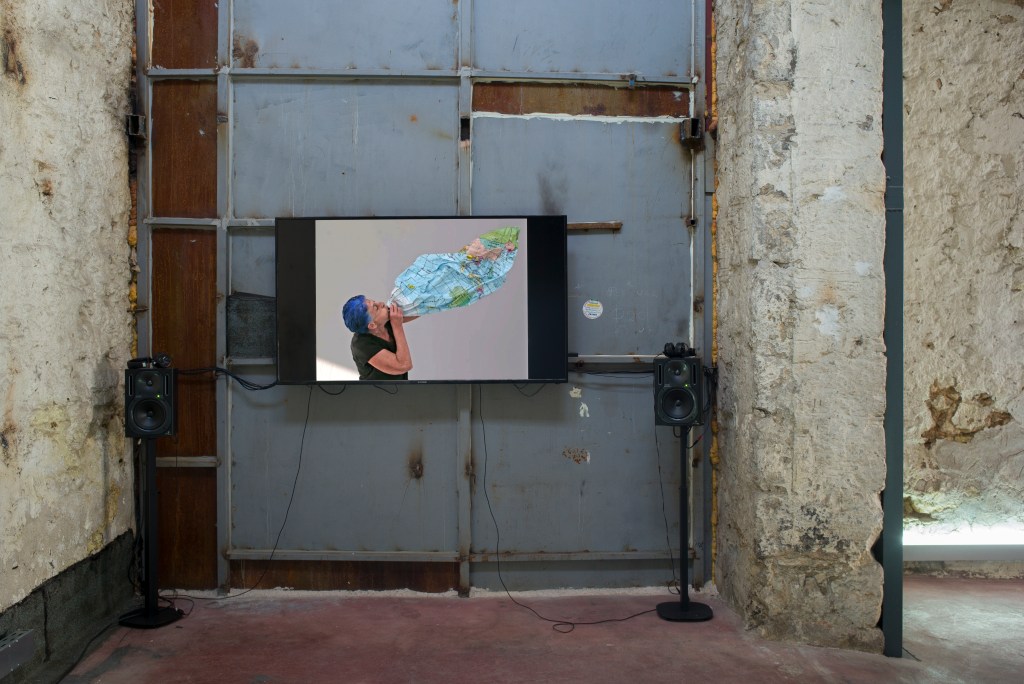
3. Eleni Mylonas, SeaMonster II, 2023, Single-channel video, Full HD, color, sound, 14′ 19′′. Courtesy of the artist.
In the performance for the camera SeaMonster II, Eleni Mylonas stages her own body among the plastic waste she has collected from the shores of Aegina, the island where she spends half the year, symbolically liberating nature from it. Her post-menopausal body refers to the wise woman, the healer, or even the witch in pre- industrial societies, and to bodies in vulnerable condition, facing the consequences of environmental and social crises. Performing for the camera allows Mylonas to join a tradition of artists attempting to reclaim the control of their image and to narrate their own ideas and experiences. Mylonas negotiates the future of the planet, the humans’ relationship with nature, and the interdependence of “bodies of water.” Mylonas’s work combines subversive humor with elements of autofiction.
4. Despina Charitonidi, Diploria Urbanis, 2024, aerated concrete, 120 × 2 × 10 cm, Courtesy of the artist and Thermia Project.
Despina Charitonidi first explored, through Diploria Urbanis, the underwater landscape of Kythnos island, revealing how aggressive construction and expansion reshape even the seabed. Her practice exposes the reach of urbanization, militarization and hyper-tourism across the Mediterranean; forces that extend the logic of development into marine environments, turning the sea into a contested space of extraction and control. Working with aerated concrete, a material central to modern architecture and coastal infrastructure, Charitonidi highlights its paradoxical resemblance to coral when carved, its pale, porous surface echoing the fragility of marine ecosystems. This tactile affinity collapses the boundary between natural and artificial. The sculptures function as speculative artefacts of a future ecology, where organic and synthetic architectures coexist in fragile balance.
 Eleni Riga
Laisser un commentaire