With works by Miriam Hansen, Simon Daniel Tegnander Wenzel, Una Hamilton Helle, Marthe Andersen and Viktor Pedersen.
Essay by the curator of the exhibition, Eleni Riga below.
Winter Nights is a group exhibition that reclaims the premises of the ancient turn-of-season rite from which it takes its name. It explores the ritual’s deep entwinement with nature and cyclical time, while considering its potential as a framework for reflecting on climate change and ecological grief.
In pre-Christian Scandinavia, Winter Nights (Vetrnætr) was a three-day festival marking the transition from summer to winter, featuring feasting and offerings to ancestors and spirits. Reflecting on Nordic animism and historian Rune Hjarnø’s writings, describing it as a means of recognizing animals, plants, rocks, waters, and spirits as “persons”, the exhibition seeks to re-establish kinship with the more-than-human world. Looking to traditions bearing this approach can offer us tools for re-entering a responsible, attentive relationship with the world.
The participating artists respond to this invitation through works that address seasonal change, power, history, magic, sleep, death, and rebirth, drawing on embodied experience, daily practices, family and land ties, as well as political concerns.
A guiding principle for the exhibition is the scotopic approach. From the Greek “skotos” (darkness), scotopic vision describes the eye’s adaptation to dim light. Here, it serves as a metaphor for ecological attentiveness: in darkness, we notice the fragile, hidden, or feared. Some works are presented in low light, inviting visitors to slow down, breathe, smell, listen while others invite us to embrace our inner darkness.
By foregrounding “Vetrnætr” as the central theme, the exhibition period coincides with the seasonal change it marks and becomes an invitation to reconnect with cyclical time, embrace rest, explore the unknown, and honor both nature and ancestral spirits. Through this, we might rekindle a sense of connection to the natural world and to one another, drawing on animist beliefs that recognize consciousness in all things.
Coming from a heliotropic society shaped by pagan traditions, I have witnessed how summer longing has escalated into overtourism, environmental devastation, water scarcity, megafires and climate injustice. By turning toward winter and darkness, I reconsider my attachment to land and seek, through ritual and myth, the courage to face what lies ahead.
In-between space
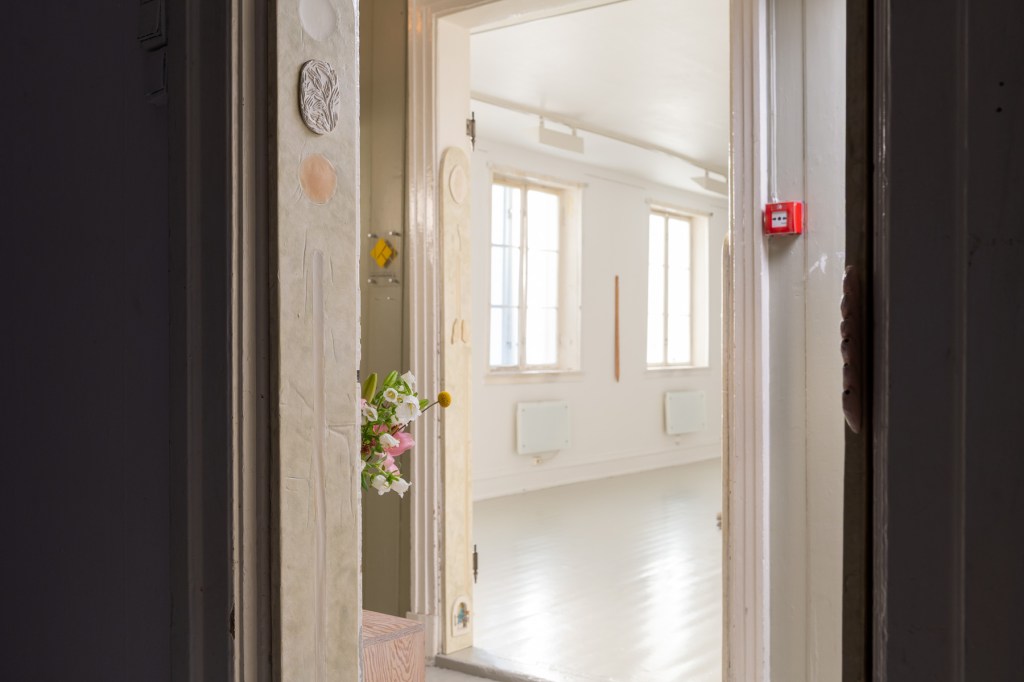
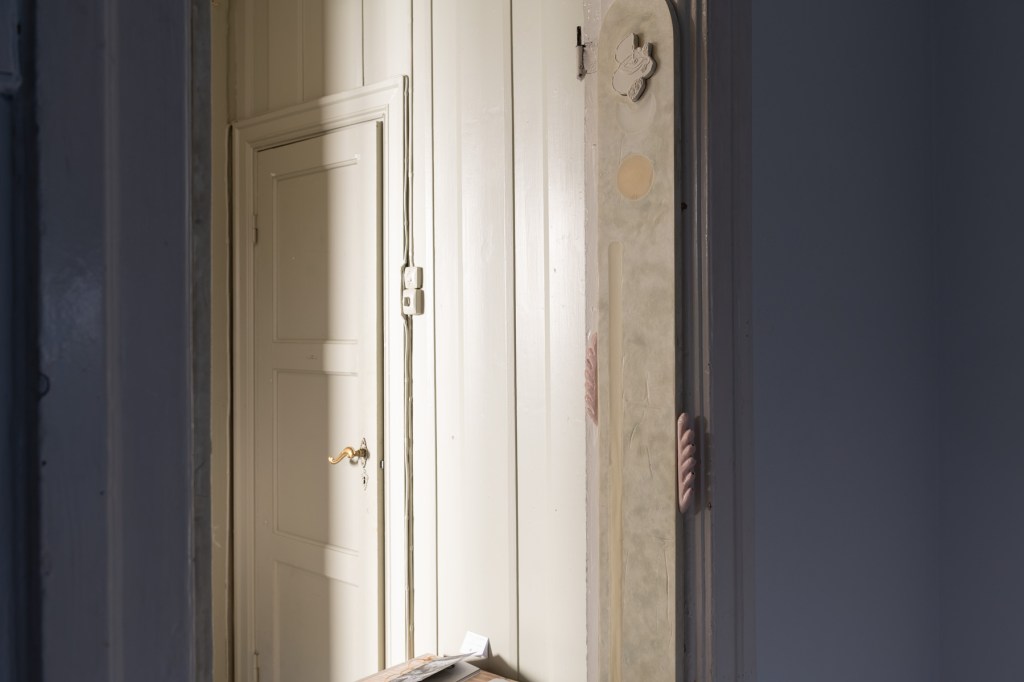
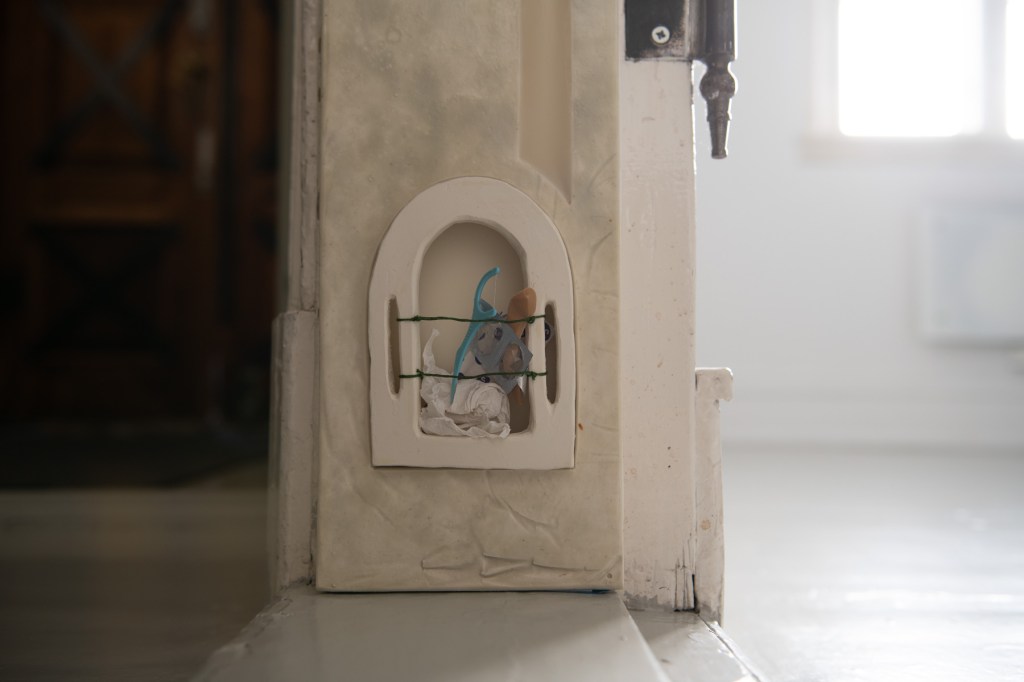
Miriam Hansen‘s mounted assemblages inhabit the transitional spaces of BO, invoking another dimension of “Winter Nights”: sedation and altered states of consciousness. Her work stages a bodily journey, moving through preliminary awareness, immersion and deep sleep. These thresholds unfold both spatially and spiritually, drawing upon folk traditions and universal archetypes, where doorframes once marked sites of protection and passage, now reimagined as liminal zones of transition.
Hansen’s practice weaves together plant infusions and contemporary sedatives. She employs organic materials such as beeswax and pH-sensitive plants that shift color over time, underscoring cycles of circularity and transformation. Everyday objects of comfort like melatonin bottles, items pulled directly from her bag, are transfigured into ritual vessels. The resulting assemblages oscillate between the intimate and the archetypal, embodying a temporal space in which living matter forms, dissolves and re-forms in endless cycles, all while critically interrogating their role in contemporary society.
Here, sedation becomes more than rest; it emerges as a seasonal suspension, echoing winter’s stillness and the temporary “death” of the natural world. Within this pause, contact with spirits and deeper forms of knowledge surfaces. In this context, Hansen’s assemblages like ritual thresholds invite visitors into a liminal space where sleep, rest and commemoration are transformed into acts of renewal.
Room 1
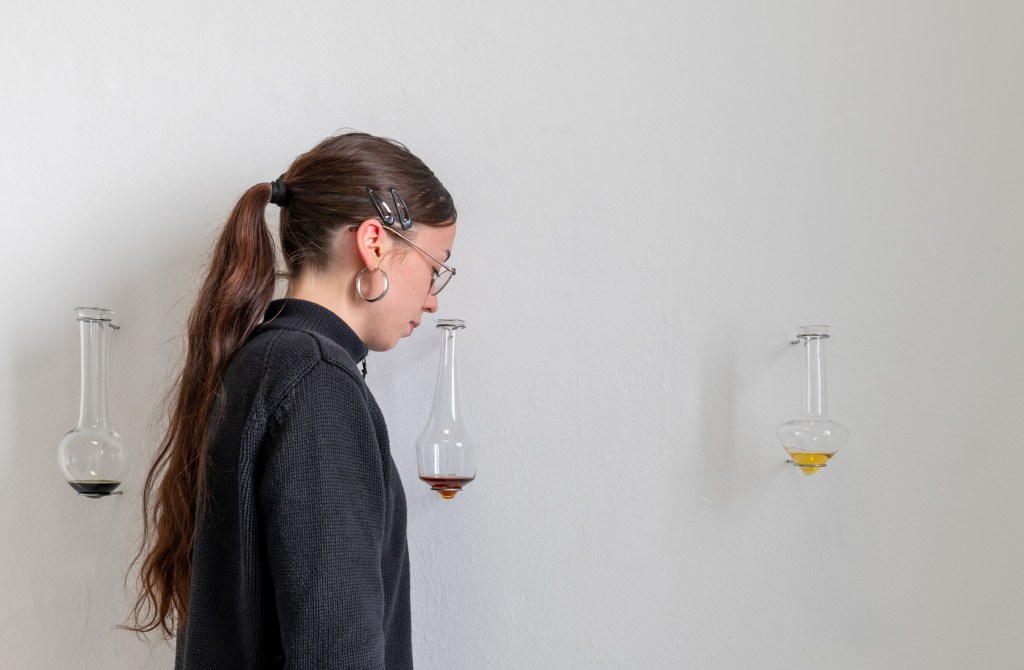
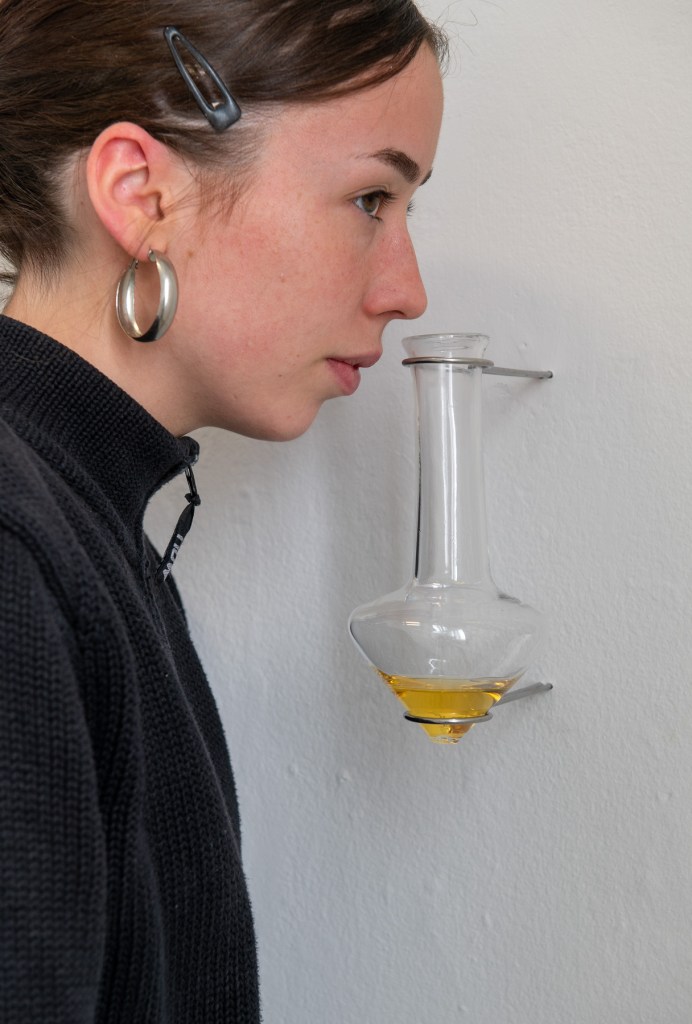
Simon Daniel Tegnander Wenzel presents a three-scent olfactory installation that explores love, loss and memory, echoing the symbolic and magical resonance of the number three throughout the exhibition.
Scent #1, Shine Kindly Here, evokes love and harvest. Inspired by Dan Forrest’s choral piece «Goodnight, Dear Heart», it conjures the golden rays of a late-summer sunset on ripened fields. Notes of autumn fruit recall the artist’s grandparents’ garden, anchoring memory in sensory experience.
Scent #2, Pyre, turns to loss, fear and death. With the scent of tar and melted metal, evoking silver required for safe passage in the afterlife, it also carries hints of burning flesh and smoked meat, conjuring rituals of fire, transformation and mortality.
Scent #3, Growing in Circles, combines spruce resin collected from Oslo Old Town’s Cemetery with pine heartwood, compounds emitted through skin by the elderly and honey reminiscent of mead offerings to ancestors. It reflects familial ties to the forest and ancestral continuity. The artist notes: «By creating this work, I see myself partaking in, continuing the growth of rings inside a tree, my generational and spiritual family tree.»
Occasionally, visitors may encounter Scent #0, Cera Anima, offered directly by the artist as a form of initiation. Containing elements from humans and farm environments, it dissolves boundaries between human and nonhuman, accessing symbolic, cosmological and psychological truths. Here, ritual is understood in Aby Warburg’s sense: as a survival of archaic states in which humans do not stand apart from nature but participate with it, physically and spiritually. Cera Anima functions as an animal costume in scent form, enabling human and nonhuman worlds to meet through gesture, trance, and transformation.
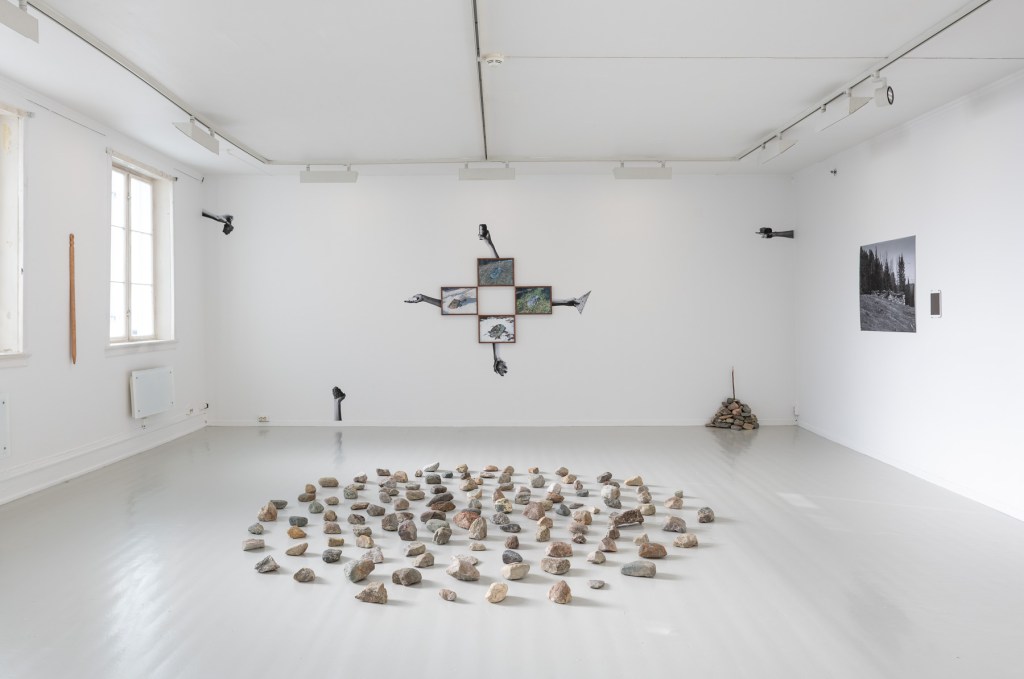
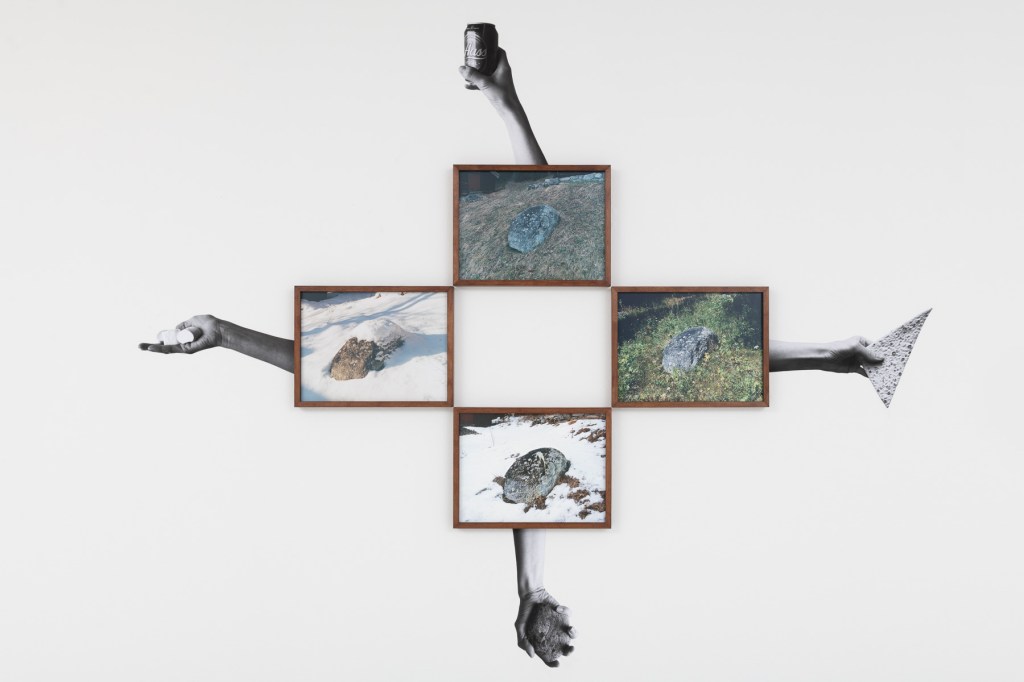
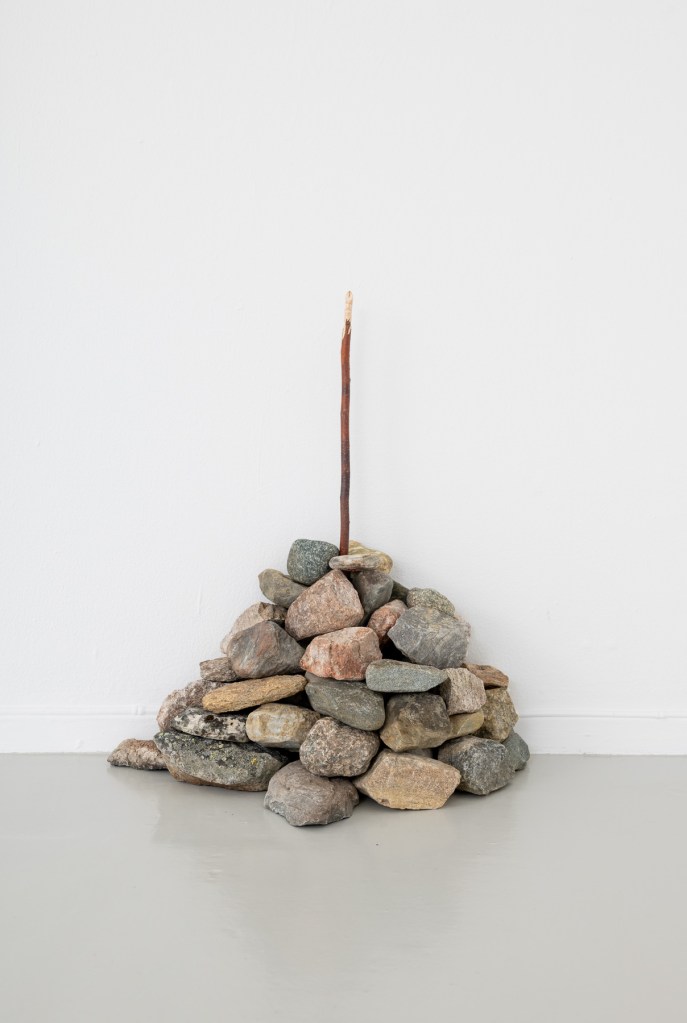
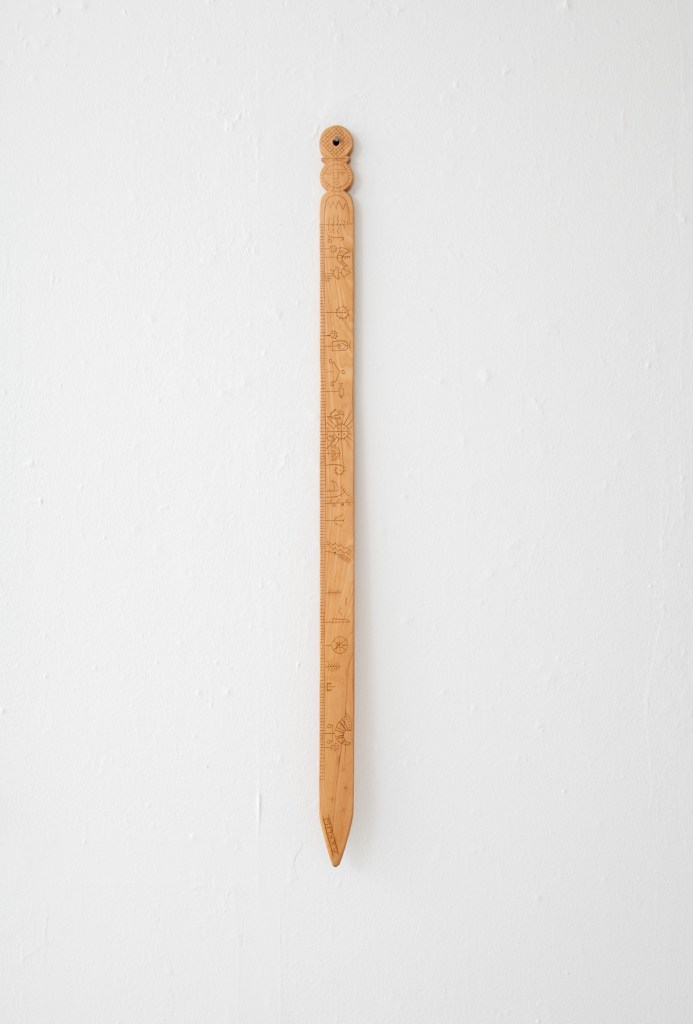
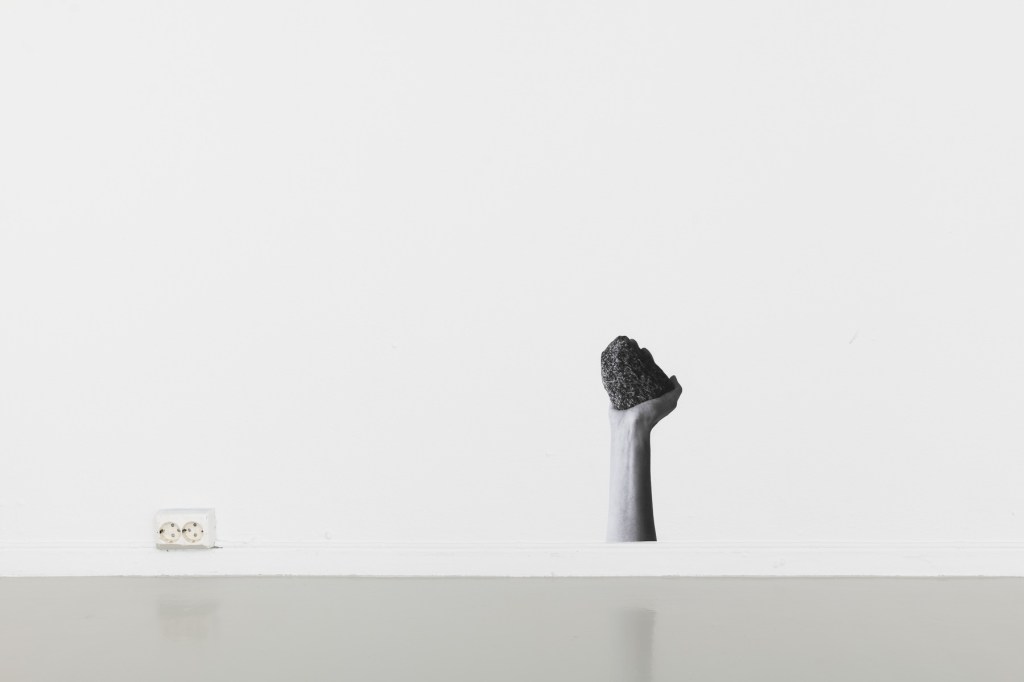
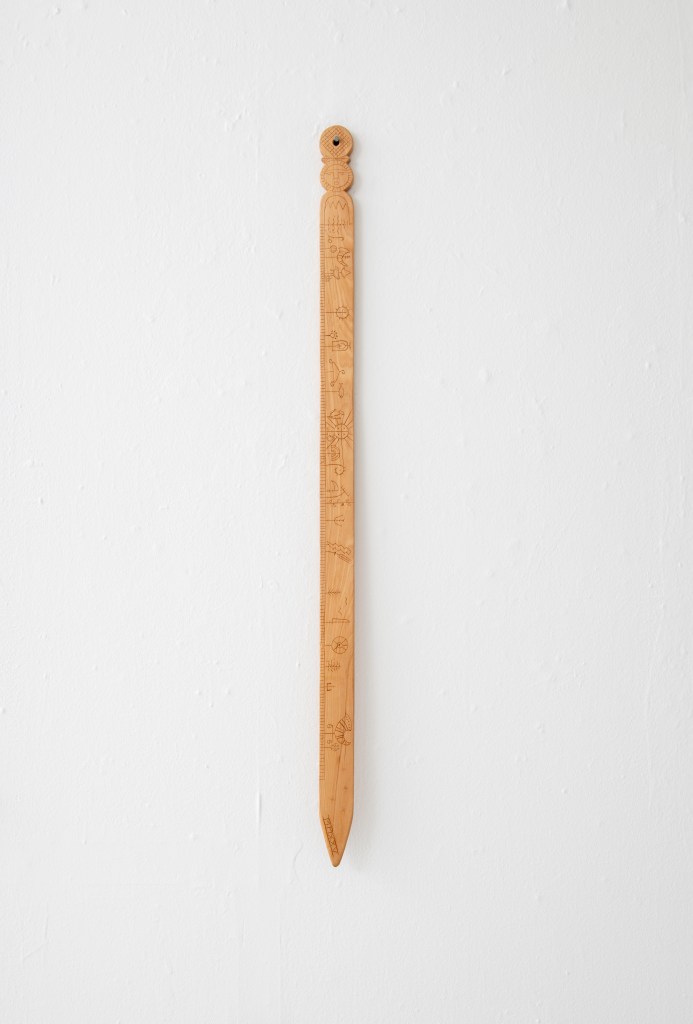
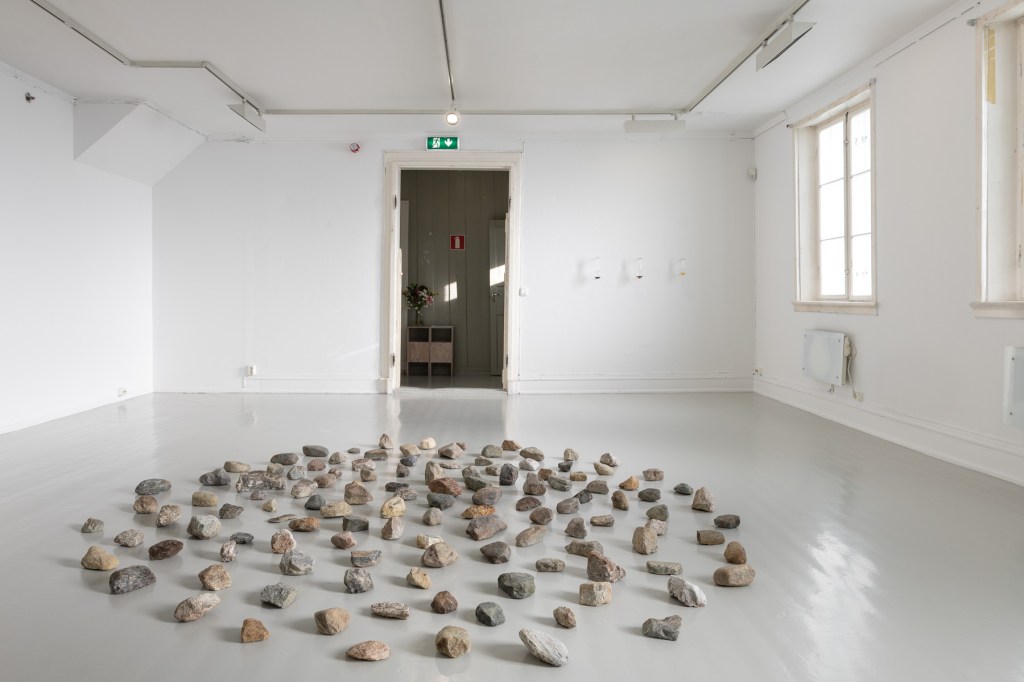
Úna Hamilton Helle presents a wall-mounted assemblage that brings together photographs, cut-outs, photocopies, the traditional Norwegian agricultural calendar primstav, alongside sculptural interventions with small stones and carved wooden sticks. Her installation unfolds as a layered, collage-like constellation, responsive to the space and attentive to the relations between objects, images and visitors.
The work is part of her ongoing project Tunsteinen (The Yard Stone), which develops from a sustained engagement with the «imaginary subterranean», as some stones were thought to be portals or homes for the land spirits that lived underground. Here, Helle asks how art can restore reciprocal, sensorial connections with the land, ones that resist extraction and instead cultivate intimacy. To this point, I would quote Susan Sontag: «The earliest experience of art must have been that it was incantatory, magical; art was an instrument of ritual.»
Human presence is suggested through gestures rather than figures: open hands offering lefse (traditional pastry), beer, or, more playfully, marshmallows, or else holding stones in a process of becoming acquainted with them. In these moments, stones emerge as active participants in the narrative, echoing Nordic animist traditions in which trees, waters and rocks are recognized as persons. The offerings, both customary and improvised, extend ancient practices into the present with a spirit of attentiveness and humility. They resist ideals of purity or perfection, instead proposing ritual as a way of fostering connection and attunement.
Helle has chosen the yard stone for its profound intimacy with place. Situated within the family’s farmstead, the stone is both marker and witness of continuity. Her inquiry begins with elemental questions: how does one enter into relation with a neighbor that is a stone—an entity so radically other, with whom no common language is shared? Over time, she has cultivated practices of attention, allowing the stone’s presence to shape the encounter. This ongoing dialogue has taken form across diverse media and is underpinned by an extended engagement with the cultural histories and ritual traditions through which stones have long been inscribed with meaning.
A central element in the installation is the «primstav» that will be turned on October 14 to mark the shift from summer to winter. As Helle notes: «Physically turning the calendar every six months made for a cyclical handling of time. A concept mirrored in the continuous re-experiencing of seasonally specific events and natural phenomena.» Such repetition imbues action with sacred meaning, as Catherine Bell observes, providing a structure through which people engage with both time and environment. In Helle’s version, the calendar incorporates not only seasonal markers but also contemporary observances such as Earth Day, World Animal Day, Pride folding present-day solidarities into older cycles. By marking time, we also make time: pausing to acknowledge, connect and participate in larger cycles of life. Helle’s assemblage ultimately functions as both offering and invitation—an attunement to land, spirits and the healing dimensions of ritual.
Room 2
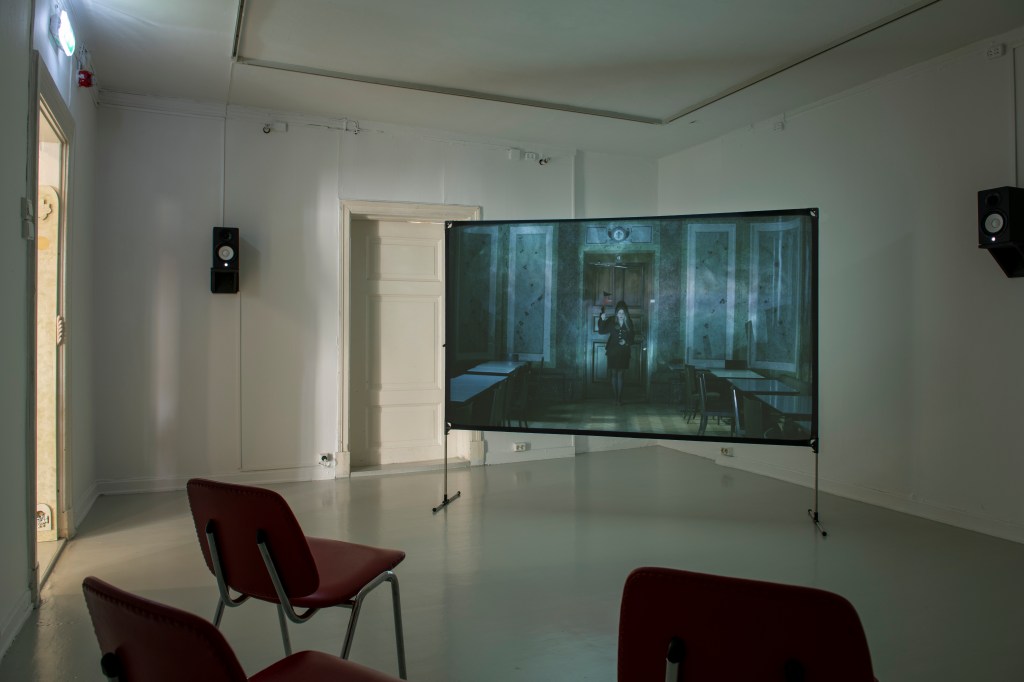
Marthe A. Andersen‘s film Dark Landscapes expands the exhibition’s reflection into the museum itself, reclaiming the old National Gallery in Oslo as a ritual site. The film traces an ideological conflict between J.C. Dahl, who defended burial mounds as sacred sites of memory and advocated for the National Gallery’s establishment, and the later Nazi regime, which sought to instrumentalize both museum and landscape for fascist propaganda.
Two paradigms emerge through Andersen’s idiosyncratic chronology, where Dahl and the Nazi regime are brought into uneasy proximity despite their separation in time. Dates and histories fold into one another, unsettling linear sequence. For Dahl, the landscape was the truest museum: the dead were not resources to be excavated or archived. The museum was not passive, nor merely decorative; it actively preserved memory, resisting the logic of human separation, bringing art and nature closer together. The Nazi regime, by contrast, exercised totalizing control over human and nonhuman bodies, employing a taxonomic logic of extraction, cataloguing and archiving that ultimately endangered the continuity of life.
Narrated by a solitary guide moving through empty halls, the film activates the space with archival fragments and projected images. The guide’s voice forms a reflective thread, guiding the viewer through layers of history and framing the museum as a site where meaning is continually reshaped. In this context, Andersen offers a poignant, multi-layered meditation on how rituals of domination have inscribed themselves upon land and memory, and how their echoes persist today, where crypto-fascist tendencies remain unsettlingly close to the surface.
Burial emerges again as a central motif. For Dahl, they belong to the continuum of life, as human bodies disintegrate and return to the soil, nourishing new beginnings. In his paintings, the human figure appears small against the monumental expanse of landscape. As the Andersen says «…He carefully weaves the presence of the dead into his vision of the living land, conjuring those who once were, but no longer are.» Andersen takes this gesture further, exploring how the invitation of darkness is inherently double-edged: on the one hand, it can manifest as harm and separation, as in the necropolitics of the Nazi regime; on the other, it can be reclaimed as a generative, even witch-like aesthetic that honors the power of burial traditions, archetypal encounters with bones and skeletons, and embodied links to ancestry where the museum itself becomes a contested ground of meaning and memory.
Crucially, Andersen does not shy away from confronting the dangers of invoking lineage, situated knowledge, or Nordic tradition when they are mobilized in the service of exclusion and violence. Instead, she reclaims these same threads to propose a counter-vision: one of reparation between human, nonhuman, and more-than-human beings, woven together into a vibrant and playful atmosphere.
Room 3
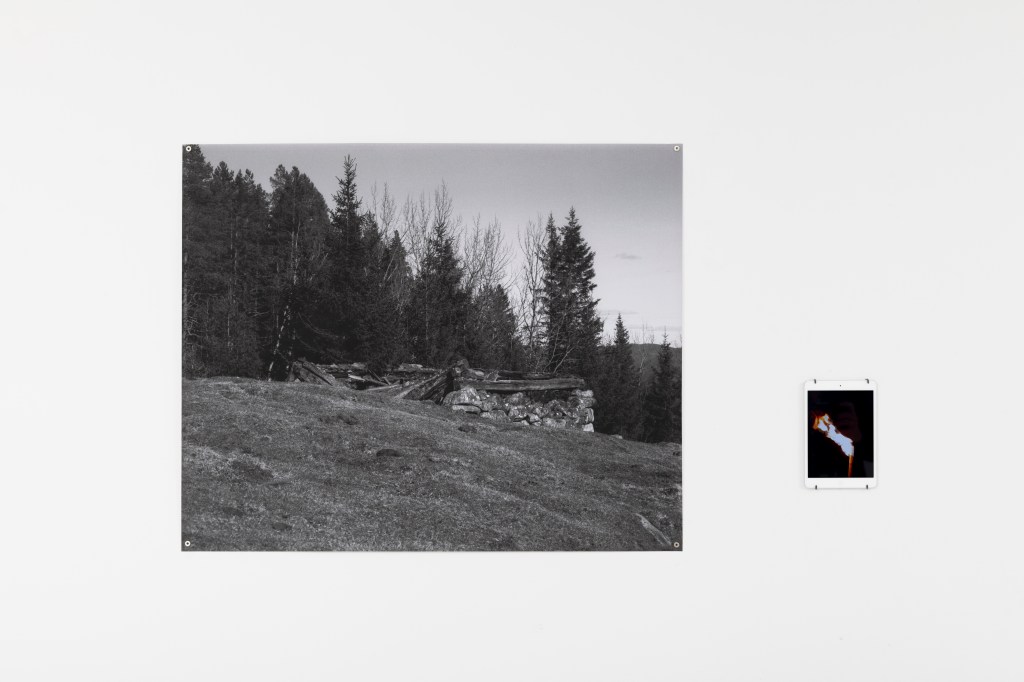
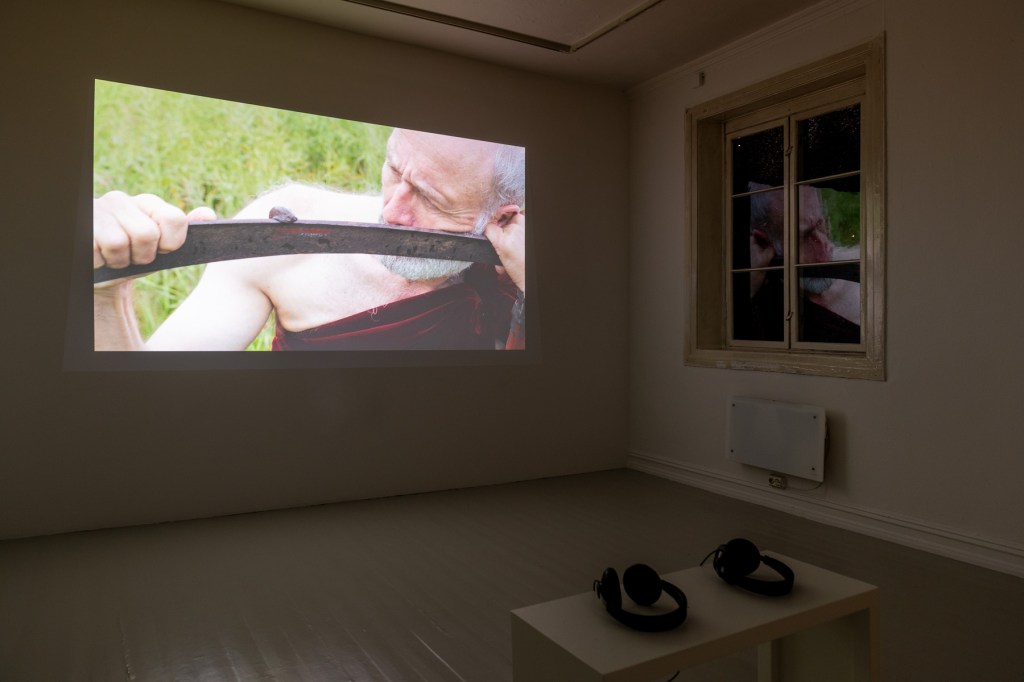
Viktor Pedersen‘s film I Am Here, All of Time is a meditation on circular temporality, birth and rebirth. Structured in a triadic form, it follows an archetypal protagonist—baby, adult, elder (Father Time)—through entangled stages of life, suggesting that birth itself is a return. The work takes place at Viking Age burial mound at Borrehaugene, close to the artist’s hometown, as both setting and cosmological axis. Here, the soil, enriched by generations of burials, becomes a living threshold where death folds back into life.
The film foregrounds uninterrupted life cycles. Although Viking cosmology and Taoist thought do not explicitly describe reincarnation, both traditions articulate a form of return, an oscillation between dissolution and re-emergence. Pedersen proposes that the universe itself “imagined him” into being as a human subject, an idea that recalls both mythic creation narratives and phenomenological speculation on consciousness. Echoes of the Upanishads resound here, particularly the passage likening existence to a spider weaving its own web, or a dreamer living within the dream: “This is true for the entire universe.” Such references expand the film’s scope beyond Norse cosmology, situating it with in a trans-cultural meditation on cosmic consciousness and the question of how individuality forms and disperses when returning to, or emanating from, the whole —that is, the undivided totality of existence from which all beings arise and to which they ultimately return.
Temporalities overlap throughout: cyclical, mythic, mineral, linear. Clocks and hourglasses punctuate the film, markers of Western chronometry in tension with other scales of time. Quartz is a recurring presence: in modern timekeeping devices and as a navigational tool in Viking Age and often found in burial cultures around the world. Quartz embodies mineral time, spanning geological epochs while anchoring the most quotidian human routines, thus collapsing distances between deep time and daily life. Another manifestation of time appears in its embodied form: the senior man personifies Father Time (Chronos in Greek mythology, Saturn in Roman), holding his scythe while measuring duration through the slow passage of a snail.
The film culminates with the artist sounding an imaginary «lur», the ancient Nordic horn historically associated with funerary rites, thresholds, and apocalyptic warnings. Here, its resonance marks an ending that is also a beginning. His film thus echoes the larger logic of Winter Nights: that endings are not final, but part of cyclical processes of renewal, and that moving beyond human-centered models allows us to glimpse the entangled scales, ecological, geological, through which existence unfolds.
Public program
Since my first visit to Oslo, I have been in sustained dialogue with Marie Askeland, artist and founder of Femidomen, a conversation that has since grown to include artist Sarah Sikorie. On Saturday, September 27, this exchange unfolds into a public program that carries Winter Nights beyond the exhibition space, taking place at Femidomen in Nesodden.
Artist Sarah Sikorie will open the carving workshop with a talk on Iron Age societies’ connections to waterbodies like beaches and bogs, highlighting wooden bog finds and their mythology. She will also present I carry my rhinestones at the center of your world, a work inspired by women’s use of staffs across history—from the vølve’s metal staff at Fyrkat, to the witch’s broomstick, to the 1980s and today’s pole dancer.
Artist Marie Gurine Askeland situates her performance beside an ancient stone, weaving agricultural myth, animal life, and embodied memory. Her narrative spans the hunt for roe deer, forgotten human–hybrid pacts, and a thousand-year oak whose hollow embodies both decay and continuity. Channeling intimacy and ferocity, Askeland draws on bodily knowledge of pregnancy, inheritance, and survival. Between vulnerability and resistance, she stages encounters with animal hunger, ancestral voices, and the ambivalence of fertility. In this liminal space, reproduction and predation, bystander and prey, converge as metaphors for ecological precarity and gendered violence.
Moving together across water and land—through reading, carving and performance—participants are invited into cyclical gestures of offering and return.
Acknowledgements
The exhibition Winter Nights has been realized with the generous support of Arts and Culture Norway and the Royal Norwegian Embassy in Athens.
 Eleni Riga
Laisser un commentaire