September 5-November 5, 2025 at the Central Train Station of Thessaloniki, Greece
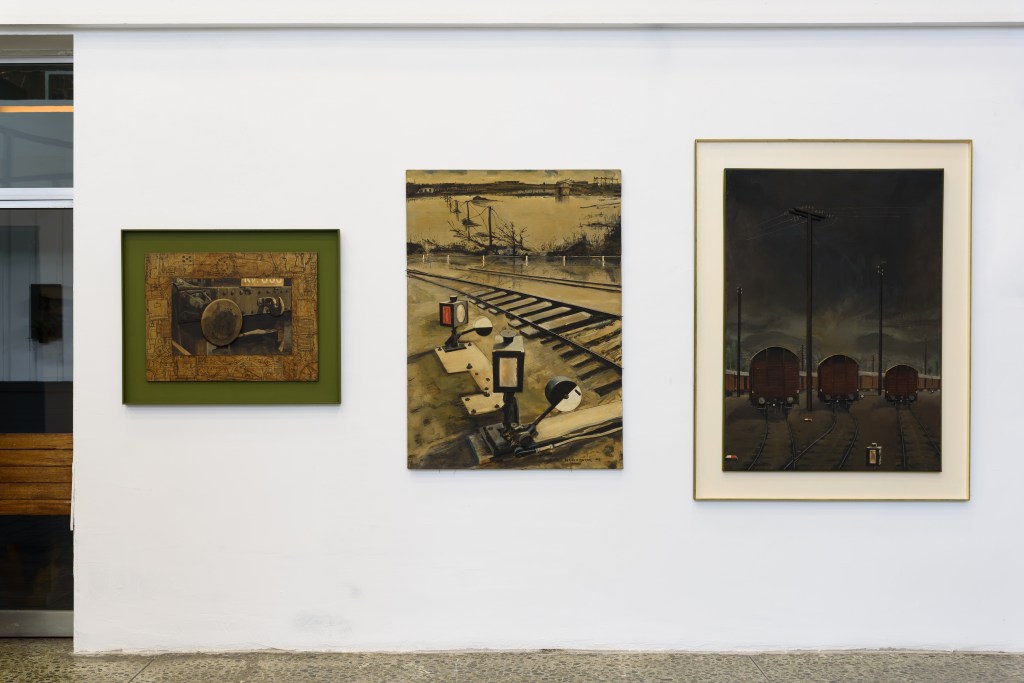
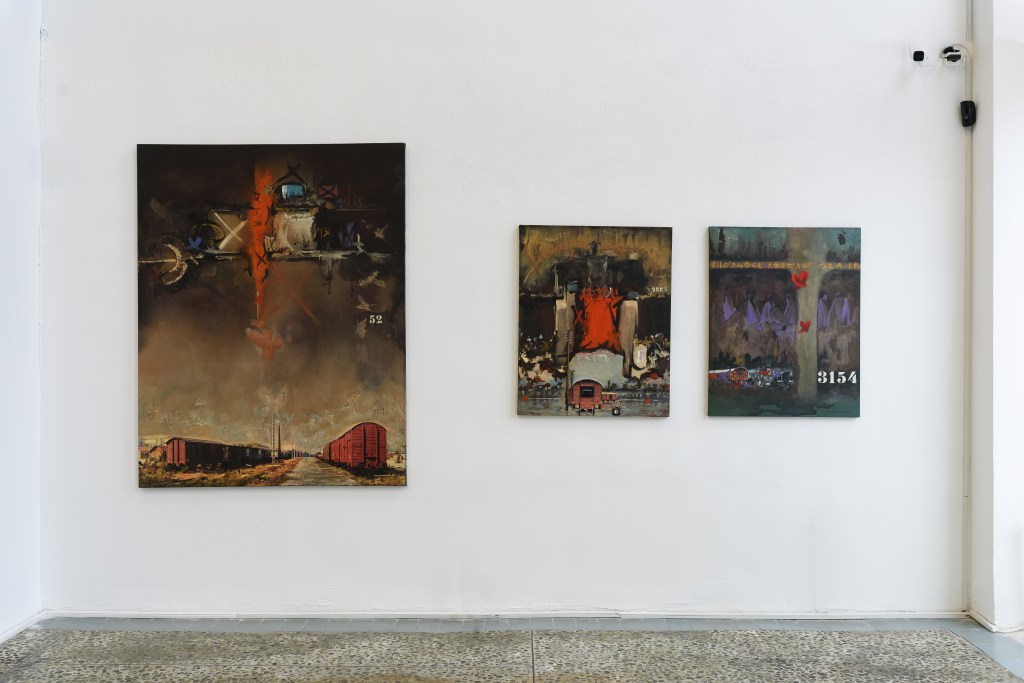
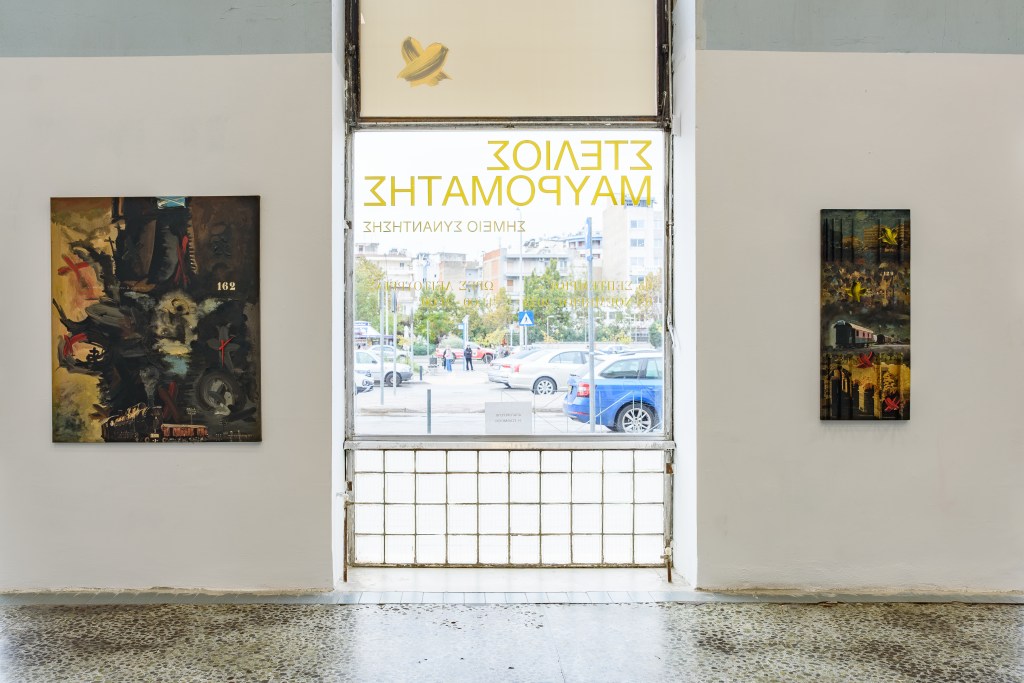
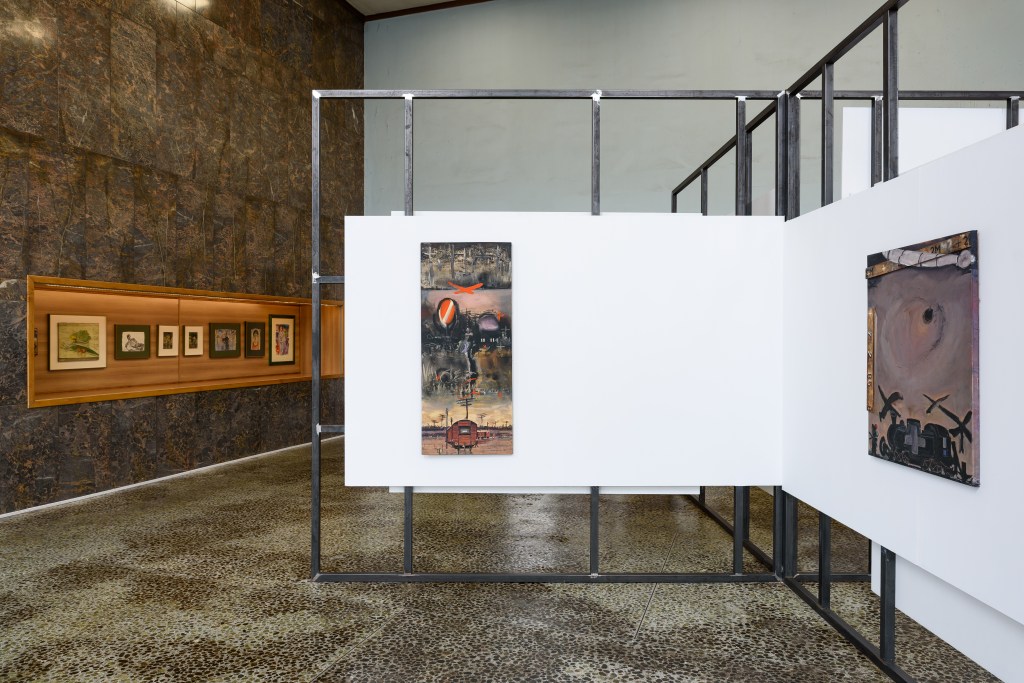
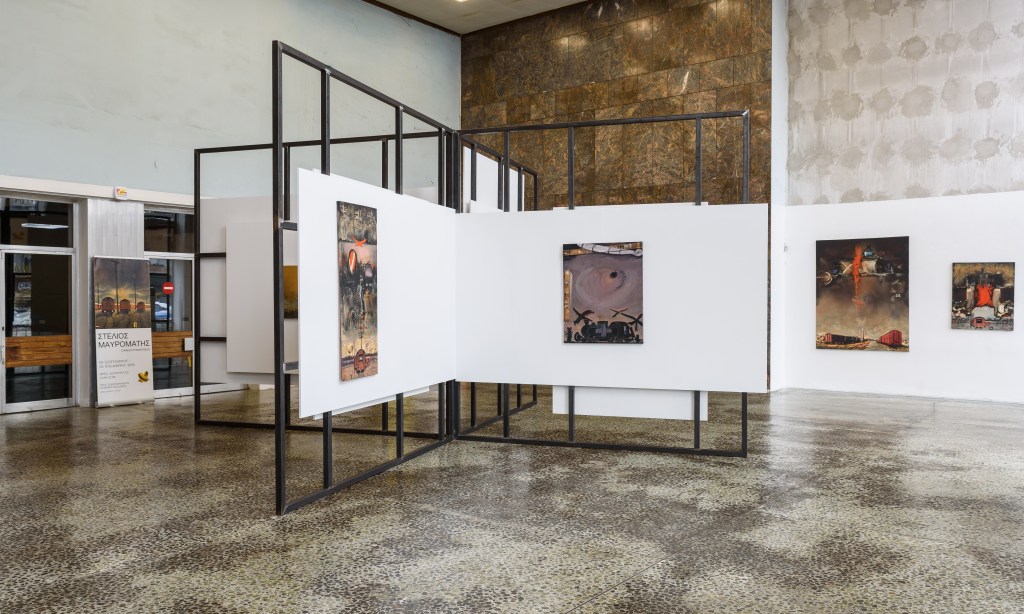
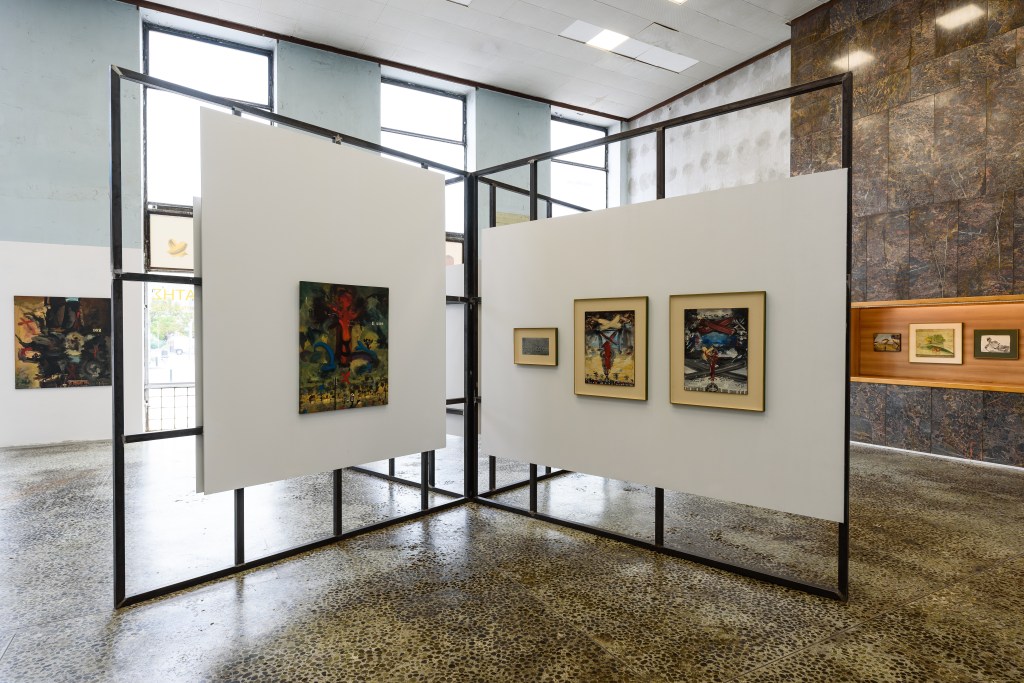
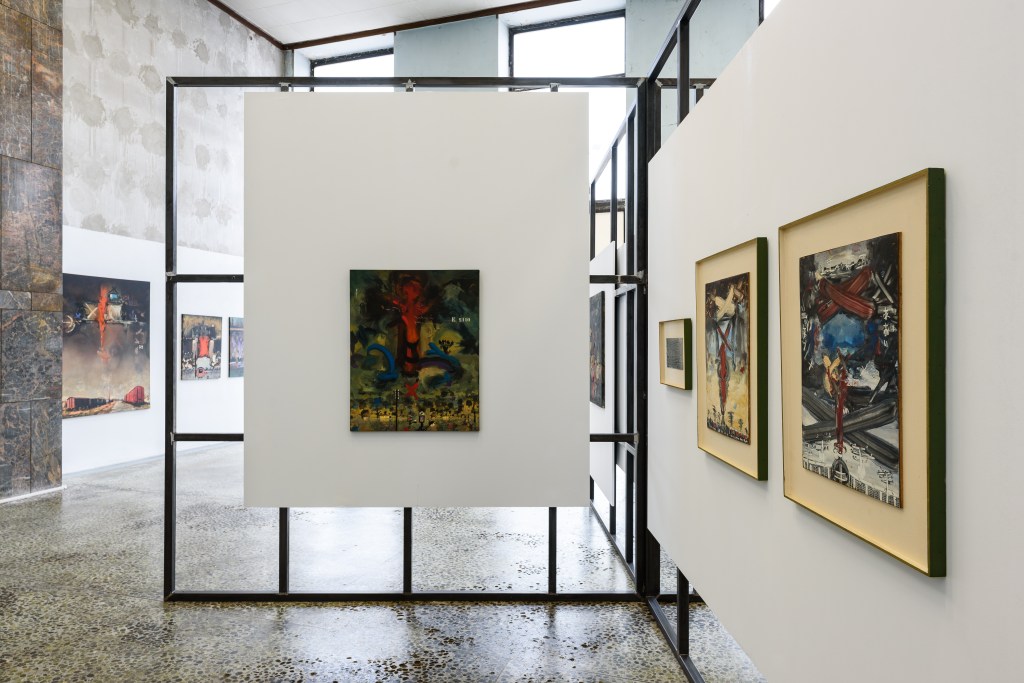
Photos by Mikele Troiani
Curatorial Note for the Exhibition “Meeting Point”
The exhibition titled Meeting Point focuses on the multilayered oeuvre of painter Stelios Mavromatis, exploring his long artistic journey through the concept of encounter—both as a tangible experience and as a transformative metaphor.
The train, a recurring motif in Mavromatis’s work, serves as a symbolic vehicle for stories, cultures, and emotions. It links the individual with the collective, the local with the global, and microhistory—the everyday experiences and personal memories of passengers and station workers—with macrohistory, encompassing the major political, economic, and social transformations in Greece and the Balkans through the expansion of the railway network. The choice of Thessaloniki Railway Station, specifically a waiting room, emphasizes the work’s role as a living site of transition, where the traveler’s experience intersects with collective memory and history.
The railway played a pivotal role in modernizing Thessaloniki and its surrounding regions from the late 19th to the late 20th century. Lines connecting Skopje–Belgrade, Monastiri, Alexandroupoli–Istanbul, among others, stimulated commercial activity, shaped industrial zones, and attracted diverse populations, transforming the city’s character. Simultaneously, the station served as a critical node for population movements: from the arrival of refugees in the early 20th century to the violent displacement and extermination of the Jewish community during the Occupation. These historical events, both past and contemporary, profoundly influenced Mavromatis, who was born in 1930 and passed away in 2000.
In his work, the train becomes a visual language, an iconography of (industrial) modernity and postmodernity, of collective memory, and of personal journeys. Mavromatis does not simply paint trains; he captures the spectrum of transition, where the city is reimagined along its tracks.
The concept of encounter permeates both the thematic and aesthetic choices of the artist. Drawing from personal memory—family, beloved poets, travels, floods, changing seasons—as well as his daily observation of the station as an “open studio” of images, he weaves elements of realism, surrealism, expressionism, impressionism, and pop art into a uniquely personal, hybrid visual language.
His visual narrative extends beyond the train. Trees, telegraph poles, crosses, warning signs, numbers, calligraphic motifs, poetic excerpts, and other symbols form a complex visual idiom, culminating in the final decades of his life in dense, metaphysical compositions. His technique is grounded in continuous experimentation with adhesives, varnishes, enamel, plexiglass, tempera, and Chinese ink—a meeting of materials that heightens the semantic richness of his work.
It is useful here to describe the mixed media technique Mavromatis developed:
“(…) The canvas or hardboard is first coated with a type of watercolor fixed with varnish. Once dried, this layer is ready to receive oil paints—primarily green, ochres, black, blue, and red—which are not mixed with linseed oil or turpentine but again with varnish for a simple reason: since the longevity of a painting depends also on the final varnish layer, it is only natural for the varnish to be integrated with the color itself.”
Although his work is not explicitly aligned with any political or ideological movement, Mavromatis’s painting is suffused with spirituality. The visual axis toward the sky or horizon suggests a desire for transcendence—a pursuit of “another place,” a personal Arcadia in the Renaissance pastoral tradition. His compositions often juxtapose everyday objects in the lower plane with symbolic forms and figures above.
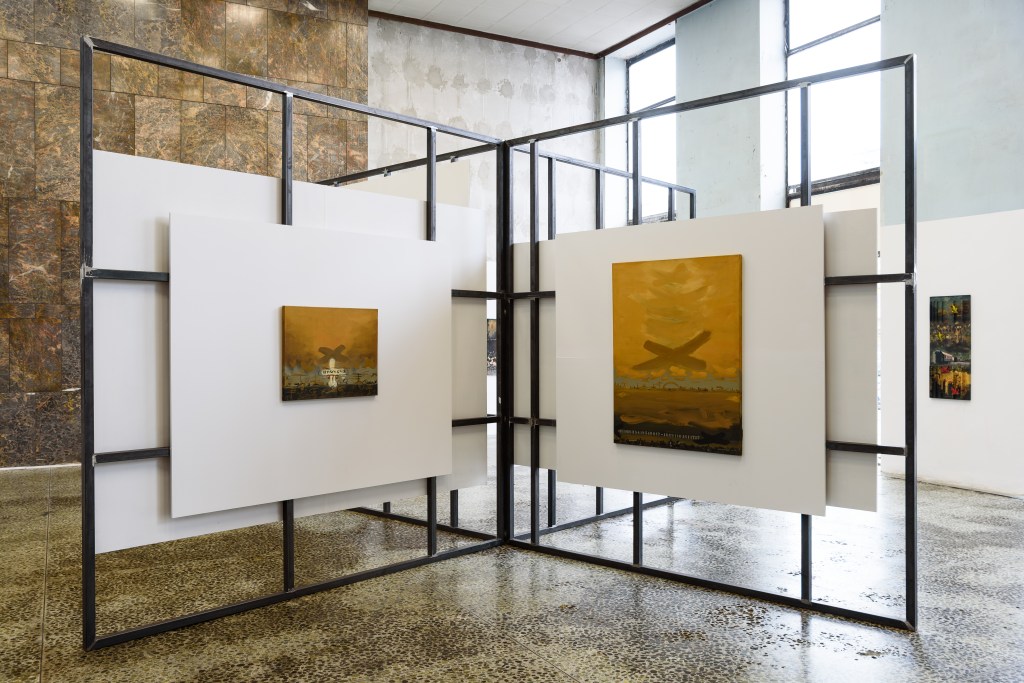
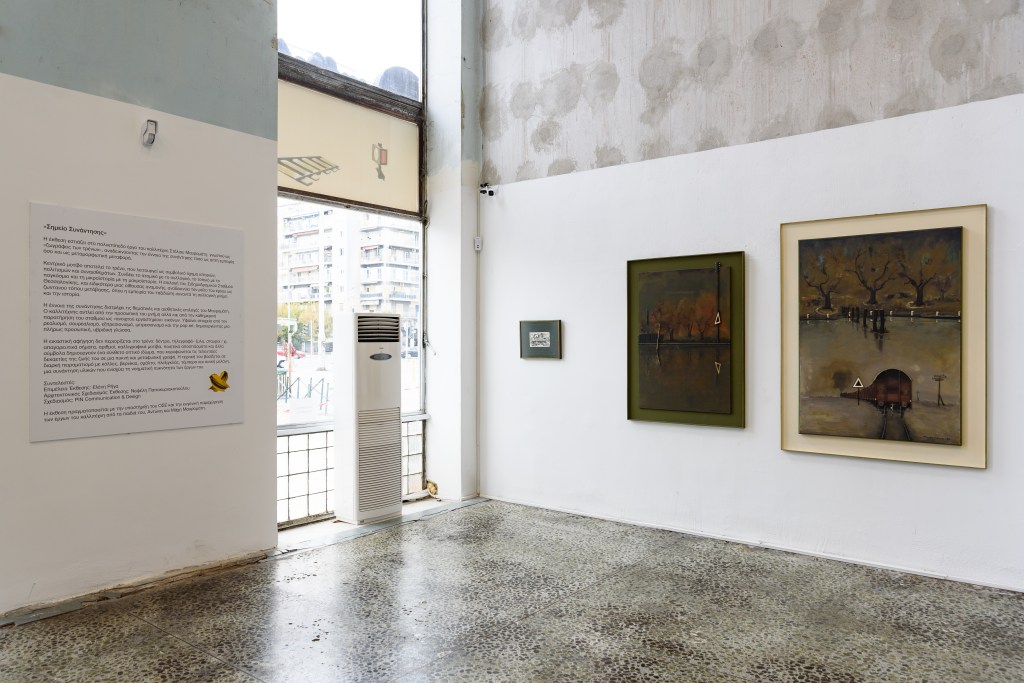
The exhibition avoids a strictly chronological framework to preserve the artist’s dynamic, exploratory spirit. The gallery walls present distinct sections in which the train serves as a central motif while highlighting technical and aesthetic shifts. Visitors gain, at a glance, a panoramic view of his work; those who linger may experience a reciprocal engagement with the artwork (Lacan) and perhaps encounter the punctum, a personal resonance that pierces the viewer (Roland Barthes). The vitrines and central installations demand closer attention, illuminating individual elements, experiments, and series that collectively constitute Mavromatis’s oeuvre.
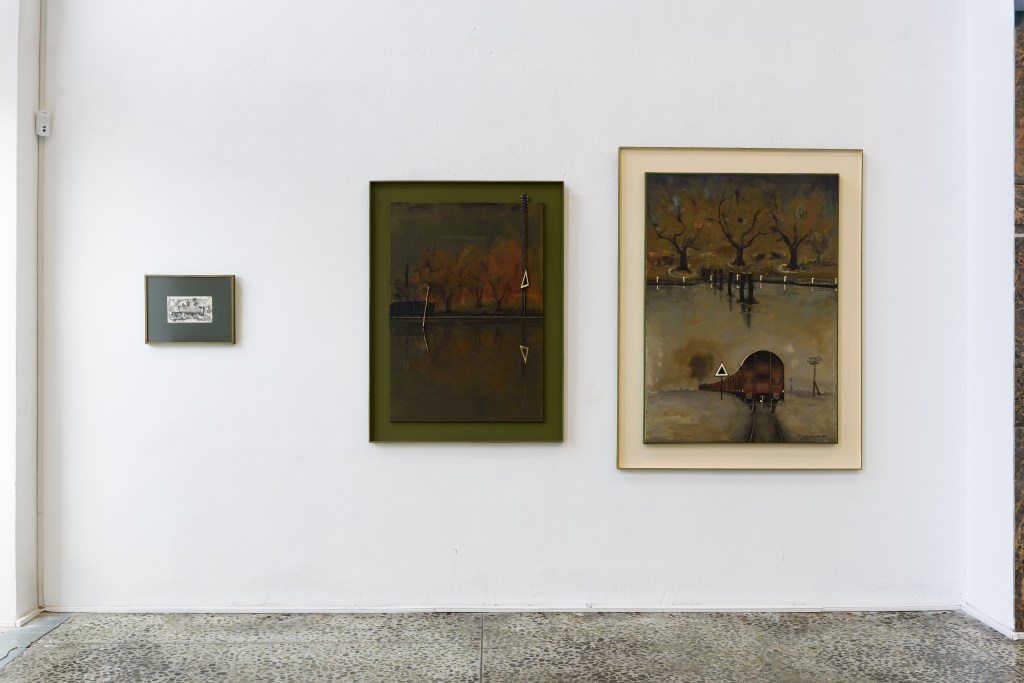
The narrative begins with The First Train (1961), a small ink drawing marking the moment the artist first became captivated by the subject. The train, briefly halting in front of his house, offered the fleeting time necessary to capture it. From that point onward, the train, once a source of disturbance, became an inexhaustible source of inspiration.
Works from 1975–1980 emphasize his relationship with nature, seasonal changes, and natural phenomena. Here, trees “settle” in the sky, creating new pictorial balances and a vivid palette. A pivotal event was the 1979 flood in Lipohori, Edessa, inspiring a series characterized by dark shades—oil greens, purples, ochres, and grays.
Subsequent works from 1975–1985 demonstrate an intense engagement with the train motif and extensive material experimentation. From 1965 onward, Mavromatis incorporated real objects into the painted surface:
“(…) Alongside oil, constructions (lines, carriage facades, telegraph poles, signs, line keys) are developed using wire, cardboard, wood, and enamel, gradually integrating into the painting surface.”
Dorothy Shinn, art critic for Beacon magazine, described this approach in her review of his exhibition at the University of Kent:
“Many paintings are made with a combination of attached and collaged elements that occasionally deceive the eye: photocopies of trains sit next to painted ones, while a telegraph pole made of wood mirrors another painted in a way that makes it appear affixed to the canvas.”
The later period, from 1982 onward, is marked by freedom in drawing, a broader color range (reds, blues, turquoise), and increased emotional intensity, evident in works from 1990–1997. These pieces often organize the painted surface into zones emphasizing the light–dark duality, with realistic elements below and symbolic or abstract motifs above (numbers, letters, calligraphy). One work from his final series, Ancient Agora, combines multiple layers and motifs: monuments, urban and symbolic landscapes, and trains rendered with stark contrasts of light and dark.
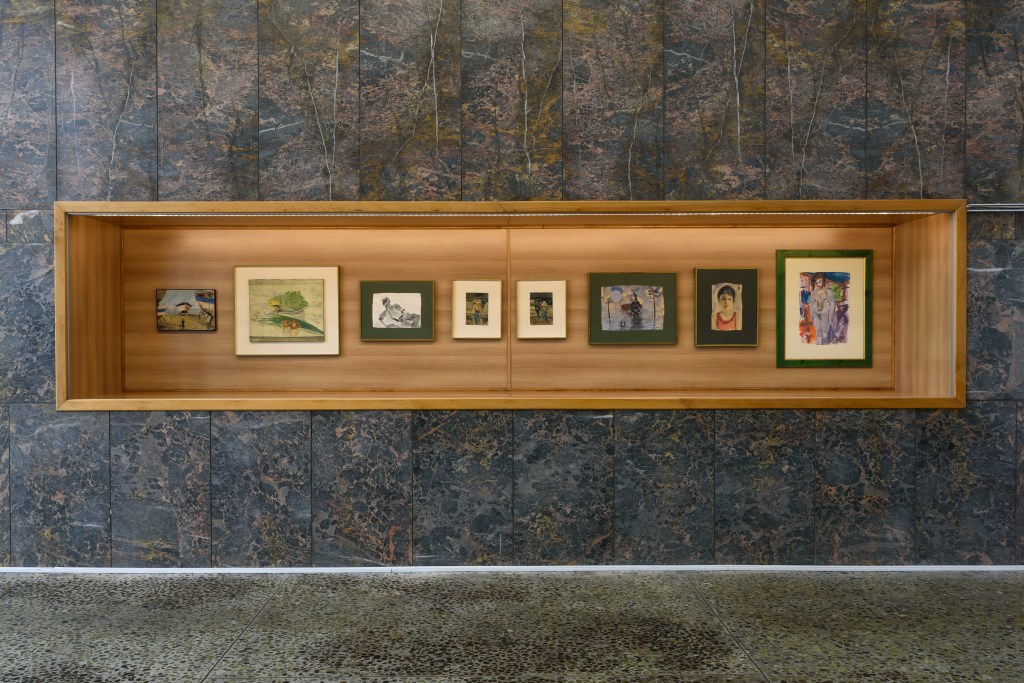
The vitrines offer additional context, revealing the breadth of Mavromatis’s practice. According to art historian Periklis Sfyridis, his career, beginning in 1956, includes still lifes, portraits, nudes, musicians, and works with folk or religious motifs, often in distinctive colors like oil greens and purples. These are complemented by maritime scenes, boats, shipyards, and general port life. Two early works with human figures—rare depictions of railway workers—stand out. The display also includes smaller works from the Erotica (1982–1991) and Egypt (1995–1997) series, demonstrating the scope of his experimentation alongside the larger works at the exhibition’s center.
At the heart of the exhibition is a non-linear narrative in which periods of creation overlap. Series, motifs, and experiments converge with more structured phases of his work, allowing visitors to experience the movement and evolution of the artist’s creative world. Clocks, warning signs reaching toward the sky with potential cosmological or transcendent symbolism, ochres, enamels made during his travels in America, and signature works from the Egypt series—combining automatic writing, expressionist forms, calligraphy, and numbers—complete the visual journey the exhibition proposes.
Eleni Riga
Credits
Exhibition Curator: Eleni Riga
Exhibition Architectural Design: Nefeli Papakyriakopoulou
Catalogue Design: PIN
Communication & Design / Catalogue Printing: Paper Graph S.A.
Warm thanks to the children of Stelios Mavromatis, Antonis and Machi!
 Eleni Riga
Laisser un commentaire